RECIPE OF THE MONTH: FREEKEH B’LAHMÉ [TIME & LEISURE] (Copy)
BY ANGELA ZAHER, TIME & LEISURE
PUBLISHED 31st March 2026
If you live in and around Reigate and enjoy Lebanese food, you’re in luck. Lebnani is an award winning restaurant in Surrey and one that I would be a regular at if I lived closer. My main gripe about Lebanese restaurants is that they tend to be reductive about our beautiful cuisine- it’s mezze and mixed grills with little else. Lebanese food consists of an enormous range of dishes using grains, pulses, herbs, spices and vegetables prepared simply and mindfully, here meaning with an awareness of what the body needs for nourishment and the soul craves for comfort. We believe in variety being the spice of life and our cuisine reflects that, but this is something that’s not showcased by many of our restaurants. Except Lebnani. There the menu, as well as having the popular staples one would expect- done with care and skill, has proper hearty everyday meals (tabkhat) we eat at home. Chef patron Jad Youssef with his entrepreneurial and charismatic wife Aga have built something truly special with Lebnani and now, anyone can have a go at recreating these dishes in their own home. Jad has written down his recipes, many that have passed through generations as well as those that bear his own stamp and flair with flavours. And the outcome of all that hard work is in his hot off the press cookbook, Lebnani.
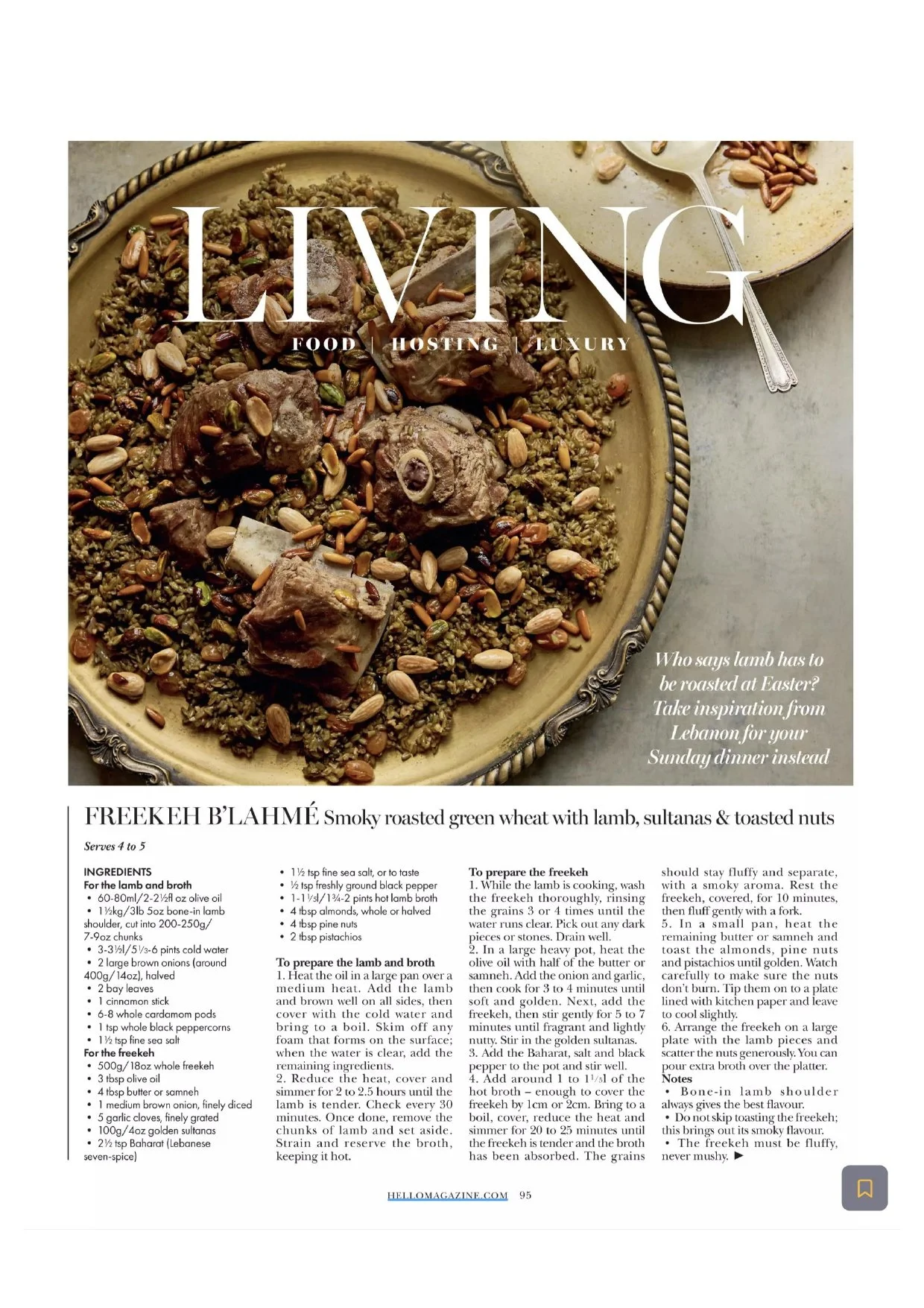
The recipe that I’ve chosen for you this month is Freekeh B’lahmé. I’ve been here for a while now and it’s about time I introduce you to one of my favourite grains. Freekeh is green wheat that’s harvested young and roasted over open flames then rubbed to remove the charred husk. It has a distinctive nutty, grassy flavour with an unsurprising smokiness given how it’s prepared. Compared with rice, freekeh has roughly double the amount of protein and almost quadruple the amount of fibre (per 100g). It’s easy to cook, with broth that it absorbs for added complexity, taste wise and goodness. I’ve done all I can to convince you, grab a bag (Waitrose stocks it as well as all other Arab or Persian food shops) and try it out!
ANGELA’S SUGGESTIONS:
There’s a nice shortcut leading to fast freekeh. Use ready made stock instead – the ones in pouches are particularly good. This way you can skip to the “prepare freekeh” section of the recipe below. If I want a vegetarian version of this dish, I also stir through a can of chickpeas at the end of the freekeh cooking process for added protein.
Angela Zaher is a freelance writer based in London. Her articles have been published in The Evening Standard, Delicious, Platinum, Good Housekeeping and Business Insider. Find her on instagram @angela_zaher
FREEKEH B’LAHMÉ
Smoky roasted green wheat with lamb, sultanas & toasted nuts
Serves 4–5
Ingredients:
For the lamb and broth
60–80ml olive oil
1.5kg bone-in lamb shoulder, cut into 200–250g chunks
3–3.5L cold water
2 large brown onions (about 400g), halved
2 bay leaves
1 cinnamon stick
6–8 whole cardamom pods
1 tsp whole black peppercorns
1½ tsp fine sea salt
For the freekeh
500g whole freekeh
3 tbsp olive oil
4 tbsp butter or samneh
1 medium brown onion, finely diced
5 garlic cloves, finely grated
100g golden sultanas
2½ tsp Baharat (Lebanese 7 spices)
1½ tsp fine sea salt, or to taste
½ tsp freshly ground black pepper
1–1.2L hot lamb broth (approx. – see above)
4 tbsp almonds, whole or halved
4 tbsp pine nuts
2 tbsp pistachios
Method:
To prepare the lamb and broth
Heat the oil in a large pan over medium heat. Add the lamb and brown well on all sides, then cover with the cold water and bring to a boil. Skim off any foam that forms on the surface and when the water is clear, add the remaining ingredients. Lower the heat, cover and simmer for 2–2.5 hours until the lamb is tender. Check every 30 minutes. Once done, remove the chunks of lamb and set aside. Strain and reserve the broth, keeping it hot.
To prepare the freekeh
While the lamb is cooking, wash the freekeh thoroughly, rinsing the grains 3 or 4 times until the water runs clear. Pick out any dark pieces or stones. Drain well.
In a large heavy pot, heat the olive oil with half of the butter or samneh. Add the onion and garlic and cook for 3–4 minutes until soft and golden, then add the freekeh and stir gently for 5–7 minutes until fragrant and lightly nutty. Stir in the golden sultanas.
Add the Baharat, salt, and black pepper to the pot and stir well. Add approximately 1–1.2 litres of the reserved hot broth – enough to cover the freekeh by 1 or 2cm. Bring to a boil, cover, lower the heat, and simmer gently for 20–25 minutes, until the freekeh is tender and the broth has been absorbed. The grains should stay fluffy and separate, with a smoky aroma. Rest the freekeh, covered, for 10 minutes, then fluff gently with a fork.
In a small pan, heat the remaining butter or samneh and toast the almonds, pine nuts and pistachios until golden. Watch carefully to make sure the nuts don’t burn. Tip them onto a plate lined with kitchen paper and leave to cool slightly.
Arrange the fluffy freekeh on a large platter. Place the lamb pieces on top or on the side. Scatter the toasted nuts generously over the freekeh. In our house, we always poured a little extra broth over the platter too – pure comfort.
Notes
Bone-in lamb shoulder always gives the best flavour.
Do not skip toasting the freekeh – this brings out its smoky flavour.
The freekeh must be fluffy – never mushy.
LEBNANI: A Journey Through Family, Food and the Flavours of Lebanon [The Twickenham & Richmond Tribune] (Copy)
BY ALISON JEE, Twickenham & Richmond Tribune
PUBLISHED 31st March 2026
This fabulous debut cookbook published this week - offers something distinct in the Middle Eastern food space: an exploration of purely Lebanese cuisine. It moves beyond the broader Levantine genre, and author Jad Youssef presents over 80 traditional recipes exactly as they’ve been made for generations. Now running Lebnani, an award-winning family restaurant in Reigate, Surrey, with his wife Aga, he was born in Beirut during the civil war. Youssef learned to cook from his mother Khadija, whose tabbouleh was famous within the family. The book combines these family recipes with personal narratives about how food sustained his family through conflict.
Mornings, Mezza at Home, Classic Mezza, Tabkha (everyday meals), Mashawi (grills), Sandwiche (street wraps), Helweyet (sweets) and Namlieh (the pantry). Here are the secret spice blends, time-honoured techniques and the beloved dishes of his mother, aunts, and grandparents that gather everyone around the table to feast family-style. Family stories are threaded throughout, tracing how food sustained Lebanese families through conflict and change. The daily rituals of shopping at souks, picking olives, baking bread and cooking together are woven into the national identity and resilience. On reading this gorgeous book, you’ll no doubt want to add a few well known Middle Eastern ingredients to your next food shop. Here in Twickenham, of course, we have two wonderful Mediterranean supermarkets so we’ve no excuses.
Here are a couple of recipes to encourage you to treat yourself to this book.
Sawda Ghanam (Lamb livers seared with garlic, lemon & Baharat) Serves 4–5
“This dish takes me back to those early mornings when my father would come home from the butcher with fresh sawda wrapped in butcher’s paper, still warm. My mother always said it had to be cooked the same day, no refrigeration, just cleaned well and straight into the pan. She’d rinse it with lemon juice, pat it dry, and sauté it with garlic, lemon juice, a little Baharat, and a kiss of heat. We’d eat it with fresh bread, fresh mint, and a raw spring onion on the side. It’s the food of real people –honest, warm, and full of soul. And just like many things in our culture, it’s meant to be shared.”
500g lamb liver (ask your butcher for very fresh, firm liver with the membrane removed)
4 tbsp extra virgin olive oil
5 garlic cloves, finely grated
1½ tsp fine sea salt, or to taste
½ tsp freshly ground black pepper, or to taste
½ tsp Baharat (Lebanese 7 spices)
¼ tsp chilli flakes or 1 small fresh
red chilli (optional)
Juice of 1 lemon
Fresh chopped parsley, to garnish
Clean the liver well and trim off any connective tissue or small veins. Slice into bite-size strips, about 1cm thick. Pat dry thoroughly with kitchen paper to help it sear properly rather than steaming. Heat the olive oil in a wide sauté pan over medium-high heat. Once hot, add the liver pieces in a single layer (do not overcrowd the pan). Let them sear undisturbed for about 2–3 minutes to develop colour, then flip and cook the other side for another 2–3 minutes.
The liver should be browned on the outside but still tender and just slightly pink inside – if overcooked it will become dry and tough. Add the garlic, salt, black pepper, Baharat, and chilli (if using) to the pan. Sauté for another 30 seconds until the garlic is fragrant. Finally, squeeze over the lemon juice and stir briefly to coat the liver. Transfer immediately to a serving plate, drizzle with a touch more olive oil, and garnish with fresh parsley.
Serve with warm Lebanese khobez, classic sides – raw onions, radishes, fresh mint – and, if it’s evening, a small glass of arak.
Salatét l’Batata (Fluffy potatoes dressed in lemon, olive oil & pomegranate) Serves 4–5
“This salad was always part of our Sunday table when I was growing up in Beirut. My mum made it early in the morning so the garlic, lemon, and olive oil could soak into the warm potatoes. When pomegranates were in season, she’d toss in the seeds for colour and sweetness. We never needed mayonnaise, just fresh herbs and good olive oil.”
800g waxy potatoes, such as Jersey Royals or Charlotte
20g fresh flat-leaf parsley
20g fresh mint leaves
2 spring onions
40g pitted black or green olives
80g fresh pomegranate seeds (about ½ pomegranate)
4 tbsp freshly squeezed lemon juice (about 2 medium lemons)
60ml extra virgin olive oil
3 garlic cloves, finely grated
1½ tsp fine sea salt, or to taste
1 tsp freshly ground black pepper
2 tbsp pomegranate molasses
Start by scrubbing the potatoes well under cold running water. Place them whole (skins on) in a deep pot, cover with cold water, and add a pinch of salt. Bring to a boil, then reduce to a simmer and cook until fork-tender, about 20–25 minutes. You should be able to pierce them easily, but they should not fall apart. While the potatoes cook, wash the parsley and mint thoroughly in a bowl of cold water with a splash of white vinegar or a pinch of salt. Swish the leaves to remove any dirt, drain, and rinse twice more under cold water. Dry completely using a clean towel or salad spinner, then finely chop and set aside.
Rinse and slice the spring onions thinly, using both the green and white parts. Cut the olives into halves or small pieces. If using a fresh pomegranate, slice it open and gently remove the seeds, discarding the bitter membrane. Once the potatoes are cooked, drain and allow them to cool slightly. While still warm (but not hot), peel by hand or with a small knife. Cut into quarters and place in a large bowl. Add the lemon juice, olive oil, garlic, salt, and pepper. Gently fold to coat all the cubes while the potatoes are still warm, allowing them to absorb the dressing. Add the chopped herbs, spring onions, olives, and pomegranate seeds. Mix again gently, just until combined, then drizzle with the pomegranate molasses.
Allow the salad to sit at room temperature for 20–30 minutes before serving. Serve at room temperature as part of a mezza, alongside grilled chicken, kafta, or fish – or simply enjoy by itself.
Back off, chocolate hummus: These are the proper Lebanese recipes you should be cooking [ The Independent] (Copy)
BY PRUDENCE WADE, THE INDEPENDENT
PUBLISHED 30th March 2026
Chocolate hummus, beetroot falafel – somewhere along the way, things have drifted. Chef Jad Youssef isn’t having it. These recipes, from his new book ‘Lebnani’, get back to the point: simple, proper, and exactly as they should be. With dishes like chocolate hummus and sweet potato falafel sweeping social media, chef Jad Youssef says he’s concerned that “Lebanese food is losing its identity”.
Lebanon-born Youssef moved from his home country in 1999 and has lived and worked all over the world – including Oslo, Hong Kong and now Surrey, where he runs his restaurant Lebnani.
Before establishing Lebnani, he says: “I started to feel like Lebanese food was losing its identity – not only in the UK, but in Europe and even in Lebanon.
“Sometimes I watch influencers – not chefs or authors of cookbooks, but influencers – trying to make meat shawarma with halloumi.”
Youssef accompanies this statement with a half-joking eye roll, continuing: “When you say shawarma or donor, it’s meat. Or when you say falafel – we know what falafel is, it’s fried, so it’s crispy on the outside, nice and fluffy on the inside, with a nice whipped tahini cream. But now you see baked falafel, or falafel with sweet potato, or falafel with beetroot.”
These “twists” on classic recipes are to “fit the Western palate”, Youssef suggests, adding: “It doesn’t make me angry, but makes me sad.”
That’s why Youssef set up his own restaurant, and is now releasing his debut cookbook, also called Lebnani – which means to be Lebanese.
“I want to focus on the classics and tradition, and make them the right way – how we do it back home, how my mum used to do it, and my aunties, and now my sisters,” he explains.
open image in gallery
A cookbook rooted in memory, not trends, and unapologetic about doing things properly (Meze)
In the cookbook, there are traditional recipes for everything from hummus and kafta (meat skewers) to falafel and tabbouleh – and you can be sure his recipe for knefe, a sweet dish made with warm cheese, pastry and orange blossom, absolutely does not contain corn flakes (yes, that is something he’s seen an influencer do online).
“It’s [enough] to drive you mad, what these people are doing,” he says. “OK, it’s good to be creative – but don’t ruin the tradition and the beauty of these nice dishes. We were all born with it and live with it. Each time I go back home, I only ask for those classic dishes to eat – that’s what I want, because I miss them.”
Lebanese food has gone global, but what do people tend to get wrong about it?
“I think when you say Lebanese, [people] straight away get an image that it’s mezze and grill only, but there’s a lot behind it,” Youssef says.
“It’s not only hummus or a tabbouleh salad, or falafel or kafta. We have over 200 dishes of mezze between vegan, vegetarian and meat, and they’re quite seasonal as well.”
That’s why the book also contains some lesser-known dishes that are staples in any Lebanese home, like fraké nayyé – a southern-style spiced lamb tartare, usually eaten in springtime with fresh warm bread and a glass of arak.
There’s also hindbeh b’zeit – a dish of sautéed wild dandelion greens with caramelised onions – and baba ghanouj, but not as people might know it. When you order baba ghanouj at a restaurant, more often than not you’ll get a smoked aubergine dip with tahini – but that, according to Youssef, is not actually baba ghanouj, but something called mtabbal.
“Baba ghanouj, it’s charred aubergine with vegetables inside it – so it has garlic, chopped parsley, spring onion, fresh mint, lemon juice and olive oil – no tahini.”
Born in 1977, two years after the Lebanese Civil War started, Youssef admits that war shaped his family’s approach to food. He suggests food was a uniting force amongst turmoil, saying: “Whatever happens, we still sit around the table and we’re going to eat.”
As the youngest of six siblings, Youssef says his older brothers and sisters were all encouraged by their parents to leave the country to “go somewhere safe”.
With the majority of his siblings studying or working out of Lebanon, it was down to Youssef to help his parents. He helped his mother with all the cooking at home, while also lending a hand at his father’s pastry shop in Beirut.
Youssef, who says he was part of “the war generation”, remembers months at a time when school would be cancelled, meaning he would accompany his mother to the market every day to help pick out ingredients for meals. This “opened my eyes” to food, he says, learning from his mum how to pick the best tomatoes, or what to look for at the butchers.
“This is where I learned about how to choose,” he says. “To work with good ingredients, good spices, good olive oil… I was born surrounded by food.”
Youssef says it was inevitable he would become a chef: “I had no chance,” he laughs. “Lebanese people, they love food, they have a passion for food.
“I go home, and in the morning, I wake up, I take a coffee, and my mum asks me, ‘So, what do you want to have for breakfast?’ Then breakfast finishes, and [my mother and my sister] are talking about what they’re going to cook for lunch. After lunch – [then what’s] for dinner…
“It’s absolutely constant.”
Stuffed Lebanese pancakes with fresh clotted cream and orange blossom syrup
open image in gallery
No shortcuts, no swaps, just the kind of dish that tastes like it should (Matt Lincoln)
“Atayef were always a treat we looked forward to – especially around Ramadan or on Sunday afternoons when visitors dropped by unannounced,” says Youssef.
“The smell of the hot saj (pan) as the batter bubbles and sets, the sight of the ashta filling being spooned in generously, the syrup dripping slowly over the soft folds – it’s simple, sweet Lebanese hospitality in a bite.
“We couldn’t resist pinching some from the tray before they made it to the guests. My mother always knew, but she let us get away with it.”
Serves: 6-8 (makes about 18-20)
Ingredients:
For the syrup:
200g caster sugar
120ml water
1 tbsp lemon juice
1 tbsp rose water
1 tbsp orange blossom water
For the ashta:
1.2L whole milk
4 tbsp white vinegar or lemon juice
1½ tbsp cornflour
1 tbsp caster sugar
1 tbsp rose water
2 tbsp orange blossom water
200g ricotta cheese (optional but recommended)
For the atayef:
300g plain flour
1 tsp dried instant yeast
1 tsp caster sugar
1 tsp bicarbonate of soda
Pinch of fine sea salt
100ml whole milk
350-400ml lukewarm water
For the garnish:
80g finely chopped pistachios
1 tbsp rose petal jam
Method:
1. To prepare the syrup: Combine the sugar and water in a small saucepan. Bring to a boil, then add the lemon juice. Lower the heat and simmer for eight to 10 minutes until slightly thickened. Add the rose and orange blossom waters, stir, and then remove from the heat. Cool to room temperature.
2. To prepare the ashta: In a saucepan, bring one litre of the milk to a simmer. Add the vinegar or lemon juice and stir gently until the milk curdles and separates. Strain and discard the whey, keeping the curds. In a clean saucepan, mix the remaining 200 millilitres of milk with the cornflour and sugar. Stir over medium heat until it thickens to a soft custard. Add the rose and orange blossom waters. Now mix the custard with the curds and ricotta (if using). Let the ashta cool completely and chill for at least an hour.
3. To prepare the atayef: In a large bowl, whisk together the flour, yeast, sugar, bicarbonate of soda, and salt. Slowly whisk in the milk and water, adjusting the quantity to get a smooth, pourable batter. Cover and leave to rest for 30-45 minutes until slightly bubbly.
4. Heat a non-stick pan over medium heat. Stir the batter gently and pour or ladle small rounds (about eight centimetres diameter) into the dry pan. Cook on one side without flipping them – bubbles will appear on top, and the surface will set. Set aside on a clean towel and keep covered so they don’t dry out.
5. Place about a spoonful of ashta in the centre of each pancake. Fold them into half-moons and pinch one edge firmly to seal, leaving the other edge open so the cream peeks out.
6. Arrange the atayef on a platter, drizzle with the syrup and sprinkle with crushed pistachios and rose petal jam. Serve immediately or chill lightly before serving.
Jad Youssef’s fasoulia b’lahmé (butter bean and meat stew) recipe. [THE WEEK]
PUBLISHED 26th November 2025
Fasoulia b’ lahmé is true comfort, a dish that reminds every Lebanese person of home, said Jad Youssef, chef and founder of Lebnani. When the smell of meat and garlic cooking fills the kitchen, you know it’s lunchtime. In our house, my mother would make it with fresh fasoulia (green beans) in summer, and jarred butter beans in the rest of the year. The beans soak up the tomato broth and the flavour of the slow-cooked meat. With rice, lemon, radishes, and a crisp salad on the side, this dish brings family straight to the table.
Ingredients (serves 4-5)
3-4 tbsp olive oil
1 large brown onion (about 200g), finely chopped
600g lamb shoulder (preferably bone-in) or beef shin, cut into large cubes
8 large garlic cloves, finely grated
3 tbsp tomato paste
4 large ripe tomatoes (about 600g), peeled and finely chopped (or grated)
1 small bunch fresh coriander, washed and finely chopped (optional)
1 bay leaf
1 tbsp fine sea salt, or to taste
1 tsp freshly ground black pepper
1 tbsp baharat (a mix of black pepper, coriander seeds, cinnamon, cloves, allspice, cumin, cardamom and nutmeg)
2 large jars good-quality butter beans (about 800–900g drained weight)
To serve:
Lebanese rice with vermicelli
fresh radishes
chilli pickles
lemon wedges
Method
Heat the olive oil in a large heavy-based pot over medium heat. Add the onion and sauté gently until soft and golden. Add the lamb pieces and cook until well browned on all sides. Add the garlic and stir gently for a minute until fragrant.
Add the tomato paste and cook for two minutes, stirring to coat the meat and onion and develop the flavour. Now add the tomatoes. Stir, and cook gently for about five to seven minutes, until the tomatoes have softened and their juices are beginning to blend with the paste and aromatics. Add the chopped coriander and stir for 2 minutes.
Pour in 1 to 1.2 litres of cold water. Add the bay leaf, salt, black pepper, and baharat. Stir to combine. Bring to a boil, skimming off any foam that rises to the surface.
Lower the heat and simmer gently, covered, for about 1½ to 2 hours, stirring occasionally. The meat should be tender and the broth rich and full-flavoured.
Meanwhile, drain the butter beans from the jar and rinse gently under cold water. About 20 minutes before the end of cooking, add the beans to the pot. Stir gently and allow them to simmer in the broth, absorbing the flavours. The sauce should thicken slightly but remain loose enough to coat the rice beautifully. Taste and adjust the seasoning before serving.
Serve hot with Lebanese rice with vermicelli, fresh radishes, pickles and lemon wedges. A generous squeeze of lemon over the fasoulia brings everything to life. This is the way we eat it in our house.
Jad and Aga expanded their Beirut street food concept to Reigate when they left the capital [THE STANDARD]
Published 22nd November 2025
When Jad Youssef and his wife Aga Ilska decided to offer Beirut’s street food to Londoners he could be fairly confident they would relish the chance to try out unfamiliar dishes like batata harra, spiced fried potato, or local beef rump marinated in spices and yoghurt.
But how might the residents of leafy commuter belt Surrey respond?
The answer has been with a resounding “yum”. When the couple left London in search of a larger home and more open space for their young family they also opened a new restaurant in Reigate.
Lebnani was awarded its first AA Rosette this year, confirming that the couple’s decision to relocate for the sake of their young family has been a sound one.
Jad, 48, and Aga, 42, both moved to London in the early noughties. They met while working at upscale, and now closed, Lebanese restaurant Fakhreldine on Green Park.
In 2009 they opened Yalla Yalla in Soho. But while the tiny restaurant was critically-acclaimed, keeping it going for 14 years was not always easy.
“The reality of running restaurants in London was becoming impossible,” says Jad.
“Landlords kept raising rents to the point where staying felt like a battle against numbers rather than a joy of cooking.
“For someone who lives and breathes authentic Lebanese food, that was heartbreaking. Food is about love, family, and connection not survival against property prices.”
Property prices were also a problem on the home front. Between them, Aga and Jad have three children. Rany, 22, Julie, 14, and Tillie, five.
The family home was a two-bedroom flat in Dollis Hill, north west London. Aga longed for more space, both inside and outside, and eventually they agreed to move to Reigate.
“London had given us so much but it had also taken its toll,” she says. “Life became too busy, too noisy, too rushed.
“We wanted something better for our kids: the freedom to grow up with the countryside on the doorstep, fresh air instead of fumes, hills to climb instead of pavements.”
In 2019 they sold their London flat for £480,000 and opted to rent for a while so they could get to know the town.
By 2023 they knew enough, and bought a five-bedroom house with a large garden for £750,000.
Lebnani opened in 2020 (lebnani.co.uk/) and Jad taking care of the cooking and Aga managing the front of house.
What foods do top chefs bring back from their holidays? [THE TIMES]
Friday August 29 2025, 5.00am, The Times
Holidays are meant for rest, exploration and, if you’re a food lover, filling every spare inch of your suitcase with edible souvenirs. We asked some of our favourite chefs what they always bring home, from extra virgin olive oil from Puglia so good it’s worth the baggage weight to the best white miso from Japan and spices that can transport you to another land. Think of it as your shopping list for the next time you’re far from home but close to something delicious.
Jad Youssef
Dried oregano and extra virgin olive oil from Italy
This year I brought back a bundle of wild dry oregano from a small family farm in southern Italy. The moment I opened the paper pouch it hit me. That intense, earthy aroma, sun-dried and hand-picked — it took me straight back to the mountains of Lebanon. It’s a much better flavour than the stuff you get in UK supermarkets. I use it generously in za’atar blends, salad dressings such as for fattoush, and even rubbed into marinades for grilled chicken or lamb. It’s rustic, vibrant and brings the soul of the Mediterranean to every dish.
Jad YoussefI never come back from Apulia (Puglia) without a few bottles of its incredible extra virgin olive oil. It’s liquid gold, fruity, bold, with just the right touch of bitterness. Perfect for drizzling over warm hummus, tossing with fresh tabbouleh or finishing a slow-cooked moussaka. You can find good versions in the UK — look for Puglian extra virgin olive oil in a blue splatter ceramic bottle. It comes from one of Italy’s oldest olive-growing regions and you can grab it at Waitrose. It’s the kind of bottle you keep out on the counter, not just for cooking but because it makes you happy every time you see it. However, there’s something magical about bringing it home yourself.
Jad Youseff is the owner and chef of Lebnani in Reigate
Lebnani’s leftover turkey dish recipe [ESSENTIAL SURREY & SW LONDON]
Spice things up this Christmas with a recipe from Lebnani Restaurant in Surrey
Don’t know what to do with your leftover turkey?! Why not introduce some spice and flavour with this mouth-watering recipe by chef Jad Youssef of Surrey’s Lebnani Restaurant.
Nestled in the heart of Reigate, Lebnani is inspired by the culture of Beirut soul food. It opened just before lockdown in February 2020 and is by the team behind the critically acclaimed small London chain of Lebanese Restaurants, Yalla Yalla. Chef Youssef uses traditional recipes passed down through generations; together with his partner Aga Ilska’s hosting skills, they have captured the essence of Lebanese culture and brought the flavours of Lebanon to the heart of Surrey.
Here is chef Jad Youssef’s receipe for Turkey Kadouche – a delicious way to use up any leftovers!
Turkey Kadouche (turkey wraps)
Serves 4-5 people.
Ingredients
4-6 pitta bread
3-4 sliced cucumber or gherkins/pickles
1 cos lettuce, shredded
1 large sliced red onion
5-6 tbsps extra virgin olive oil
½ tbsps sea salt
2 tbsps pomegranate molasses
½ tbsps coarse black pepper
1 tbsps brown sugar
Ingredients for zaat’ar labne
500g natural yoghurt
1 tbsps Zaa’tar
1 whole grated cucumber
1 tbsps sea salt
8-10 chopped fresh mint leaves
Method:
Pull the leftover turkey and reheat it in its liquid/sauce.
In a separate pan, heat the olive oil, add the sliced onion and sauté for 10-15 minutes until soft; season and add the sugar and pomegranate molasses.
Cook until caramelized for another 10-15 minutes, then mix all together with the turkey and simmer for 10-15 minutes on low heat.
Make the labne by mixing the natural yoghurt, zaa’tar, grated cucumber, chopped mint, and seasoning.
Take a pitta wrap and spread labne in the middle, add the shredded cos lettuce, sliced cucumber and the turkey, roll and enjoy.
Expand
This Christmas, Lebnani is also offering two thoughtfully curated Christmas hampers, which make a perfect gift for any foodie or home cook. Choose from The Beirut Box (£38), filled with the likes of Lebanese extra virgin olive oil, spice mixes, pomegranate molasses, fig jam with roasted sesame seeds, pistachio backlawa, and more. The Luxe Beirut Box (£75) contains much of the same, with the addition of a bottle of delicious Lebanese wine, premium tahini, and more. Both hampers are presented in gold boxes and include exclusive recipe cards from Chef Jad Youssef.
Originally published: Lebnani’s leftover turkey dish recipe - Essential Surrey & SW London
For more information about Lebnani Restaurant (11 Church St, Reigate RH2 0AA), its hampers (available for nationwide delivery) and more, visit www.lebnani.co.uk
THE HANDBOOK CHRISTMAS GIFTS GUIDE
What’s Christmas without a house full of festive delights and sweet treats to keep the family belly-full until the new year? We’ve handpicked the best Christmas food and drinks gifts 2023, from decadent cheeses to Christmas tipples, chocolate stocking fillers to artisan condiments.
Originally published: Christmas Food & Drinks Gifts 2023 - An Editor's Top Picks (thehandbook.com)
Lebnani Restaurant Launches Lebanese Hampers [Honest Mum]
Popular Surrey restaurant, Lebnani kindly sent us their new hamper, the Luxe Beirut Box as an early Christmas present to celebrate the launch of two of their thoughtfully curated Christmas hampers which will bring the delicious, magical flavours of Lebanon to your festive celebrations. This is a unique, delicious and premium gift should be on your gift list this year, for sure.
But back to these tasty treats.
With two price points, (£38 and £75), whether for family, friends, a colleague, your children’s teacher or even as a treat for yourself (my favourite, ha), they truly make the perfect present.
With exclusive recipe cards from Lebnani Chef Jad Youssef (previously of the popular Yalla Yalla restaurants, and Picadilly’s Fakhreldine) accompany the quality ingredients for inspo in the kitchen.
The Observer’s Jay Rayner previously described Jad’s cooking as, “It is food that makes you feel like you are engaged in an exercise of profound self-care. It’s “me time” in a succession of beautifully dressed plates.” High and deserved praise indeed.
We’re total foodies here so I’ll be making homemade hummus with the Extra Virgin Olive Oil, tahini and herbs as well as desserts using the fragrant, sweet orange blossom water such as trifle or rice pudding. The pomegranate molasses makes for a tangy and refreshing salad dressing, mixed with olive oil. Yum.
Bursting with flavours from Beirut, the two hamper options, presented in gold boxes, include:
The Beirut Box
£38
– Jar of Lebnani Sumac, 60g
– Jar of Lebnani Zaatar spice mix, 60g
– Bottle of Zet Zeytoun Lebanese Extra Virgin Olive Oil, 250ml
– Bottle of Chtoura Pomegranate Molasses, 250ml
– Jar of Mrabba fig jam with roasted sesame seeds, 330g
– Jar of pickled baby cucumber 300g
– Pistachio Backlawa
– Recipe card from Chef Jad Youssef
The Luxe Beirut Box
£75
– Bottle of Chateau Heritage, Nine
– Jar of Lebnani Sumac, 60g
– Jar of Lebnani Zaatar spice mix, 60g
– Bottle of Zet Zeytoun Lebanese Extra Virgin Olive Oil, 250ml
– Bottle of Chtoura Pomegranate Molasses, 250ml
– Bottle of Chtoura Orange Blossom, 250ml
– Jar of Mrabba fig jam with roasted sesame seeds, 330g
– Jar of pickled baby cucumber 300g
– Pistachio Backlawa
– Jar of El Yaman Tahini
– Recipe card from Chef Jad Youssef
Lebnani Christmas Hampers are available for pre-order and orders from 16 October 2023, with nationwide delivery options, to ensure delivery before Christmas and during the festive celebrations. Authentic, beautifully presented, importantly, delicious and utterly unique, we adored our hamper.
For more information about Lebnani, the hampers and to order visit www.lebnani.co.uk
Originally published: Lebanani Restaurant Launches Lebanese Christmas Hampers (honestmum.com)
Food Glorious Food [Your Surrey Wedding]
If you’re not sure when it comes to your big-day food and drinks, this A-Z guide will be a start! We caught up with Aga Ilska one of the founders of Reigate’s Lebnani Restaurant and Debbie Turney of Surrey’s Sea Change wine to talk all things Lebanese and local wine and editor, Sarah.
When it comes to food and drink, local and seasonal is a great option. Lebanese feast offers your guests a communal dining experience with vibrant flavours and the warm hospitality of Lebanese culture.
Be sure to think of everyone when planning your menu. From children-friendly fingers food to offering vegetarian and vegan options. Ask guests for their dietary requirements and review your guests list beforehand to make sure you have everyone covered.
Offer something special for non-drinkers with Lebanese lemonades in a range of flavours - apple, mint and ginger or pomegranate and orange blossom.
MEZZE a delicious alternative to a standard starter! Offering Mezze encourages guests to mingle and chat as they share and sample the dishes.
SHAWARMA - be it beef or chicken Shawarma would make a sure to please late-night snack for dancing guests.
EXTRA TREAT - finish your meal with a traditional amuse bouche like Turkish Delights, that works for vegan guests too!
Offer your guests a sweet treat. Backlawa is a sweet pastry often served as a dessert at Lebanese weddings.
For your evening food, a general rule of thumb is to provide 75% of your total guests, as not everyone will be in the mood for eating once they’ve hit tha dancefloor and will be happy to stick to the cake!
Originally published: https://www.county.wedding/image-upload/flippingbook/YSYW103/50/
Small but perfectly judged [Guardian]
One taste of its gloriously zingy Lebanese flavours and you know you’re in the right place.
With the bad places, the moment never comes, however much you might wish it were otherwise. Perhaps you make allowances for the clumsy service, or the overblown decor, or the try-too-hard menu splattered with simpering adjectives – Sumptuous! Delectable! Toothsome! – which leave you muttering, “I’ll be the judge of that.” You accept all of that in the hope that something you have ordered will arrive and you’ll take one look at it and know, in the way you know your own name, that everything is actually going to be fine. With the bad places, that dish never arrives.
With the really good places, the moment always comes early. At Lebnani in Reigate, the first reassuring sign comes very early indeed: a glass bowl of small, intensely flavoured black and green olives, delivered to the table with the water. It is as if their compactness has concentrated their very brackish essence within the taut, shiny skins. They are mixed through with salty, chopped preserved lemons, and flecked with the red of diced peppers. We pick at them compulsively, sometimes with cocktail sticks, sometimes with our fingers until their tips are shiny with the oils. We soothe the lightly bitter edge with glasses of their own lemonade, flavoured with apple and ginger, or pomegranate and orange blossom.
Then the Beirut fattoush arrives and we know, from the merest glance, that we really have found our way to the right table. It’s a beauty. The thin curls of deep-fried flatbread are golden and lightly oiled, and dusted with the deep purple of sumac. Some of that citrus promise has found its way on to the bright green of the leaves and cucumber beneath. Shiny, pert, ruby jewels of pomegranate finish the picture. You know it’s going to be fabulous to eat, long before you even lift your fork in ardour, and it is: crisp and fresh, bright and zingy. It is food that makes you feel like you are engaged in an exercise of profound self-care. It’s “me time” in a succession of beautifully dressed plates.
Advertisement
The executive chef and proprietor at Lebnani is the Beirut-born Jad Youssef who, back in 2008, set up what became the small Yalla Yalla group of Lebanese restaurants in central London before selling up. For a while he led the kitchen at the much fancier, now closed, Fakhreldine and then joined a similar restaurant in Hong Kong as executive chef. Now he’s also here in Surrey’s commuter belt, with a menu of meze at around £6 a plate and bigger dishes in the mid-teens. From Tuesday to Friday, they’ll do you a wrap with salad, hummus and pickles for £11.95. Apparently, Youssef divides his time between the two restaurants which, given the 5,989 miles between them – thank you nice Mr Google for that precise figure – sounds like a challenge. In truth, it sounds like a recipe for phoning it in.
Clearly, however, he knows how to staff a restaurant and transmit recipes from afar. Or perhaps we should just give all the credit to the people who actually cook and serve the food here on a daily basis. Lebnani is a small but perfectly judged, perfectly run restaurant, with its pretty half-tiled floor in white and blue and its turquoise cushioned banquettes and its open kitchen pumping out the smells of good things grilling over charcoal.
Little of the proposition will surprise anyone who considers themselves reasonably well versed in the classic repertoire of the eastern Mediterranean. Versions of these dishes can be found from one end of the Middle East to the other. Here is the offer of falafel and hummus, of tabbouleh and shish kebabs. But at Lebnani it comes with an especially light, fresh touch. Bring on the squirts of lemon juice and the dribbles of deep green olive oil and the finely chopped fresh herbs. Bring on the sunshine.
It is a reminder to me of how much I love the cooking of Lebanon. The small, tightly wrapped, rice-stuffed vine leaves, topped with a dice of tomato, are each a perfect mouthful. There is an especially light, almost frothy aubergine purée, smoky from the grill, the flavour deepened by the generous addition of garlic and tahini. The well in the middle is filled with that olive oil, dancing with the green of chopped chives. The hummus here is extremely creamy: it dollops on to the soft pillows of flatbread like the best garlicky whipped butter. For an extra £1.50 they add a small heap of their sweet, tender beef shawarma, banging with the baharat seasoning in which it has been marinated overnight, a billow of nutmeg and cumin, of paprika and clove and more.
We have two of the charcoal grills. There are hunks of chicken shish, the breast marinated in lemon and a paste of red peppers, to give the charred meat a rich bronze lustre. On the side is a pot of their toum, the brilliant white whipped garlic sauce. Then there’s the kebab of minced and spiced lamb shoulder, seasoned with allspice, with its own little dish of tahini sauce to help it on its way. Both come on the same impeccable bed of rice, spun through with vermicelli, that Lebanese miracle of rice cookery in which every buttery grain is merely hanging out together rather than clinging starchily to the next for security. There are roasted sweet peppers and sumac-marinated tomatoes, and a red onion salad.
The only thing they do not make here is the baklava. It’s a fine example, but pay more attention to the muhalabia, a soothing set milk pudding topped with crushed pistachios and sweetened with a light touch of rosewater syrup. Bar a prosecco, the entire wine list comes from the great houses of the Bekaa Valley and Mount Lebanon, and includes affordable offerings from the venerable Chateau Musar. Next door is a branch of Café Rouge, which seems to be doing rather better business this lunchtime. It’s not better priced; indeed, if anything, you’ll run up a smaller bill at Lebnani. I do, of course, accept some people would prefer faux French to banging Lebanese. I know people make these choices. The problem is, I just don’t understand why.
Originally published: https://www.theguardian.com/food/2022/sep/25/jay-rayner-restaurant-review-lebnani-reigate-small-but-perfectly-judged
Beirut Soul Food [Squaremeal]
About Lebnani
This new Lebanese restaurant in the heart of Reigate comes courtesy of Yalla Yalla founder Jad Youssef and serves dishes inspired by the cooking of Youssef’s Beirut childhood. Lebnani offers a selection of mezze dishes, larger plates and dishes from the grill, and uses locally sourced ingredients where possible.
First impressions might lead you to believe that Lebnani offers an impersonal dining experience thanks to its relatively minimalist interior – pale green and grey shades coat the room and the odd plant dangles from the walls. Look a bit closer though and you’ll see a few framed photographs, as well as a mishmash of ornaments, providing references to Youssef’s childhood home – a nicely intimate touch.
The lengthy menu begins with mezze dishes and it’s suggested that two people should share three or four. These range from dips such as hummus and labné to grilled halloumi, spiced fried potatoes and rice-stuffed vine leaves. Most of the menu is veggie-friendly and if you want to stay vegetarian with the larger plates, moussaka and roasted cauliflower with tahini are both good shouts.
Meaty offerings from the grill include chicken wings marinated in toum, lemon and pomegranate molasses, and spiced minced lamb shoulder with tahini, all of which come served with khobez bread and salad. On weekdays there’s also a great set lunch deal, which includes pitta, hummus, rice and a choice of three main dishes from the grill for just £11.50.
Wash the food down with a fascinating wine list which features almost exclusively Lebanese wines, with the odd bottle from Greece and North Macedonia thrown in for good measure.
With Yalla Yalla, Youssef brought a welcome contemporary take on Middle Eastern cooking to central London, informed by the first-hand experience of someone with an in-depth knowledge of the cuisine. Lebnani proves that Youssef has lost none of his determination to bring the cooking of his birthplace to a wider audience.
A Taste of Home [Surrey Life]
Sharing is encoraged at Lebnani BELOW: Fresh tabouli with parsley, mint, tomato, onion, olive oil, lemon juice, and bulgar wheat
Lebanese chef Jad Youssef tells Simone Hellyer about plans to showcase the flavours of his Beirut home at his new Reigate restaurant, Lebnani
The vibrant flavours of Lebanon are set to come to Reigate this February with the opening of new restaurant Lebnani. The restaurant, located on Church Street, is the brainchild of Beirutborn executive chef, Jad Youssef, who also founded London-based Lebanese street food restaurant Yalla Yalla.
Between helping his mother make home-cooked meals and assisting his father at work in his pastry shop, Youssef grew up in the kitchen and says it is his mission to share his Lebanese cooking heritage around the world. “Food culture was massive in my family,” he says. “I’ve always adored my mum’s kitchen in our Beirut home, it is a place where I have learnt the key insights of Lebanese food. Beirut home is part of me, it goes wherever I go.”
After completing his culinary training in Beirut, Youssef embarked on a restaurant career that saw him working in top kitchens around Europe. He opened Yalla Yalla in 2008 and his rustic Lebanese and Middle East flavours gained praise from Time Out London, which named his dish Sawda Djej (chicken liver in pomegranate molasses) as one of its ‘Best 100 Dishes in London’. He has also appeared as an expert judge on Celebrity MasterChef.
On why he chose to open Lebnani in Reigate, Jad says: “Lebanese food outside London is not in full blossom yet, and the idea of developing and popularising Lebanese cuisine here was the key factor for me.”
The menu will focus on authentic Lebanese dishes such as, Arnabit (roasted cauliflower with tahini, harissa and sumac labné), Beirut Fattoush Salad (Romaine lettuce, vine tomato, radish, red onion, mint, pomegranate dressing, sumac tossed khobez pitta) and Roasted Beef Shawarma (marinated with Baharat and served with sumac tatbila salad and tahini).
“I believe in fresh ingredients, and in food made by people with love,” Jad adds. “Our ethos is all about authentic classic Lebanese dishes simply cooked using the best locally sourced ingredients to suit all tastes.”
The flavours may be exotic, but Jad promises many of the ingredients on Lebnani’s menu will be sourced locally: “We only use the finest ingredients; spices, herbs and grains are imported directly from Lebanon and our meat is sourced responsibly from local farms in Surrey and Sussex.”
When asked what his favourite dish on the menu was, Jad wouldn’t be drawn: “I won’t tell you my favourite dish since I love the idea of sharing mezze. A variety of flavourful hot and cold dishes lets you enjoy all the flavours and is a real treat everyone should have.”
Originally published: https://www.pressreader.com/uk/surrey-life/20200122/282651804440633